
Brass Jewelry Wholesale: What Changes at Scale
Going from 100 pieces to ten times that does not change the design, the plating recipe or the sampling process — it changes packaging, carton labelling and how many times the mould is warmed up. A wholesale brass run still starts at 100 pieces per design, and a 1,000-piece order passes through the same eight factory steps as a 100-piece one. What shifts is where the fixed cost lands.
Key takeaways
- Eco-brass keeps a 100-piece-per-design minimum whether the order is 100 pieces or 10,000.
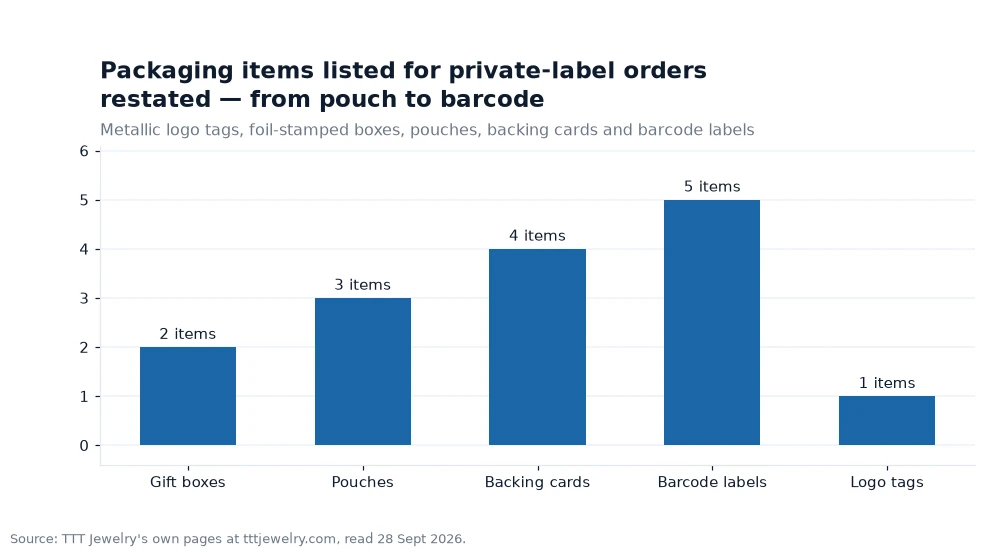
- The five listed packaging items — tags, boxes, pouches, backing cards and barcode labels — are what scale.
- Multi-layer gold or rhodium plating still runs as one tank pass per finish per order.
- 100% inspection is per piece, so it scales with volume rather than being sampled away.
What scale changes, and what it does not
The design, the mould, the CAD file and the plating recipe are identical at any quantity. The eight-step process does not shorten or skip a stage because the order is large; sprue cutting, polishing, surface art and electroplating happen per piece either way, and final inspection is listed as 100% of the batch.
So the honest answer to "what changes at scale" is: the fixed part of the work gets spread over more units, and the variable part — the part that is genuinely per piece — scales exactly with the order. Tooling is on the fixed side. Packaging, labelling and inspection are on the variable side. A buyer who confuses the two usually gets an unpleasant surprise at the packaging stage.
Packaging is the first thing that changes
The customisation list includes five packaging items: microfiber or velvet pouches, a metallic logo tag, barcode labels, backing cards and gift boxes with foil stamping. Each has its own quantity logic, and none of them is the jewelry. A foil-stamped box is produced in runs decided by the printer, not by the plating tank, and that mismatch is where a wholesale order most often stalls.
Barcode labelling is the item people forget. Once a collection is sold through any channel that scans, each piece needs a label that matches the packaging it ships in and the carton behind it. Asking for barcodes at the packing stage rather than at the design stage means reprinting at least one layer of the packaging, and possibly re-boxing the run.
| Packaging item | Decided by | Scales with |
|---|---|---|
| Metallic logo tags | Logo file and finish | Piece count |
| Foil-stamped gift boxes | Print run and stamping plate | Carton count |
| Velvet or microfiber pouches | Pouch supplier minimum | Piece count |
| Display backing cards | Card print run | Retail units |
| Barcode labels | Channel and SKU structure | Every scanned unit |
MOQ stays, and that is the useful part
The MOQ for custom brass jewelry is 100 pieces per design in artisan eco-brass, and it does not rise with a larger order or fall with a smaller one — it is a floor set by tooling, not a ladder. Silver sits at 50 pieces per design and stainless steel at 100+. A wholesale catalogue of twelve brass designs is therefore twelve toolings, and the floor applies to each one separately.
That is why a ten-design wholesale launch is usually staged rather than issued in one message. Tooling, sampling and finish approval all run per design, and a factory working through twelve new designs in parallel is running twelve sampling sequences at once. Two batches of five is a slower launch and a faster response to whatever sells.
What the brass line adds once the order is large
Scale does not change the recipe: advanced gold and rhodium plating layers sit over the brass with anti-tarnish protection, described on the line as a durable barrier that suits most skin types. What scale changes is the inspection load, because the brass route finishes with manual inspection of craft, finish, gem setting, size and structure on every single piece rather than on a percentage of them.
Shipping is the other end of the same idea. Jewelry-specific packaging and trackable shipping are named as the final stage, which matters more at 1,000 pieces than at 100: a carton that cannot be traced is a batch that cannot be reconciled against the order. With packaging already one of the six customisation options, the packing list and the tracking reference belong in the same approval as the design.
Worked example: where the fixed part lands at 10x
Compare two orders of the same design: 100 pieces, the published floor, and 1,000 pieces, which is 100 × 10. The tooling cycle — CAD, mould, first sample sign-off — happens once in both cases. Spread across the small order, that fixed work is carried by 100 pieces; across the large order, by 1,000, so the tooling burden per piece falls by a factor of 1,000 ÷ 100 = 10.
Now look at what does not fall. Plating still runs as one tank pass per finish for the batch, inspection is still 100% of pieces, and every unit still needs a pouch, a tag and a label. So the savings at scale sit in the fixed tenth of the process and nowhere else. My arithmetic; the 100-piece floor and the eight steps are the published figures.
Chains and findings behave differently at volume
Chains and findings are the one customisation line a factory buys rather than makes. A cord, a clasp or a jump ring arrives in stock lengths and finishes, so the quantity decision is about how many complete pieces will be assembled rather than about a tooling run. At 1,000 pieces the chain is ordered in the length the design needs, in the plate that matches the pendant, and cut to size in the same pass.
At 100 pieces the same chain may only be available in a stock length, which means the finished piece hangs slightly differently from the sample. That is worth checking during sampling rather than after a large run: ask for the chain specification in writing, along with the clasp type and the finding finish, because a finding in the wrong tone is more visible on a display card than a millimetre of extra length on a pendant.
Ordering the whole thing in one message
Six customisation options are listed for an order, and the efficient way to use that list is to settle all six in the first message rather than discovering them one at a time: chains and findings, packaging, stones set as accents, material selection, finishes and plating and logo and hallmarks. TTT Jewelry runs each of those as a stage with its own approval, so a missing answer on any line becomes a delay on the whole batch rather than a delay on that line alone.
Stone choice is the line most often left open. Natural stones and freshwater pearls are both listed as options, and both have a supply pattern of their own, which can move a sampling date without anything changing on the bench. Naming the stone, the size and the cut at CAD stage is what keeps the sampling window at 25–30 days instead of discovering a substitution later.
Frequently asked questions
Does the minimum order quantity fall for a larger wholesale order?
No. The 100-piece floor for artisan eco-brass is set by tooling per design, so it applies whether you order 100 pieces or 10,000.
Which parts of a wholesale order get cheaper per piece at volume?
The fixed work — CAD, mould making and first sampling — because it happens once and is then spread across more units.
Can packaging be added after the jewelry is produced?
It can, but each packaging item has its own production run, so ordering boxes, cards and labels alongside the jewelry avoids a stalled carton.
Planning a wholesale run without stalling it
Write the packaging specification on the same page as the design specification, then stage the designs so the sampling queue stays short. The pieces to settle first are the barcode structure, the pouch size relative to the largest piece in the range, and which finishes repeat across designs — because a repeated finish is one tank recipe rather than four similar ones. The manufacturer publishes the full OEM/ODM route for brands that arrive with finished drawings and for brands with only a concept, and the plating and finishing detail behind every order is described on the wholesale jewelry page. If the range also includes white metal, the stainless steel division runs the same sequence through PVD rather than a wet tank.
The basis for every figure above — the gold and rhodium plating layers; the recyclable-brass statement plus the REACH and Prop 65 statements — is the maker's own site at tttjewelry.com, read 28 Sept 2026. Nothing else here is inferred. The three-way comparisons of minimums belong to me rather than the client, and nothing else here[1].