
Stability Questions to Settle Before Signing a Travel Retail Deal
Most travel retail supply agreements are signed before the shelf-life questions are answered, and the answers then arrive as change requests with a price attached. The fix is unglamorous: settle nine questions in writing, assign each one an owner, and make the answer a condition of signature rather than a task for the first production meeting. A supplier that can answer them plainly is telling you something about how it will behave after the order.
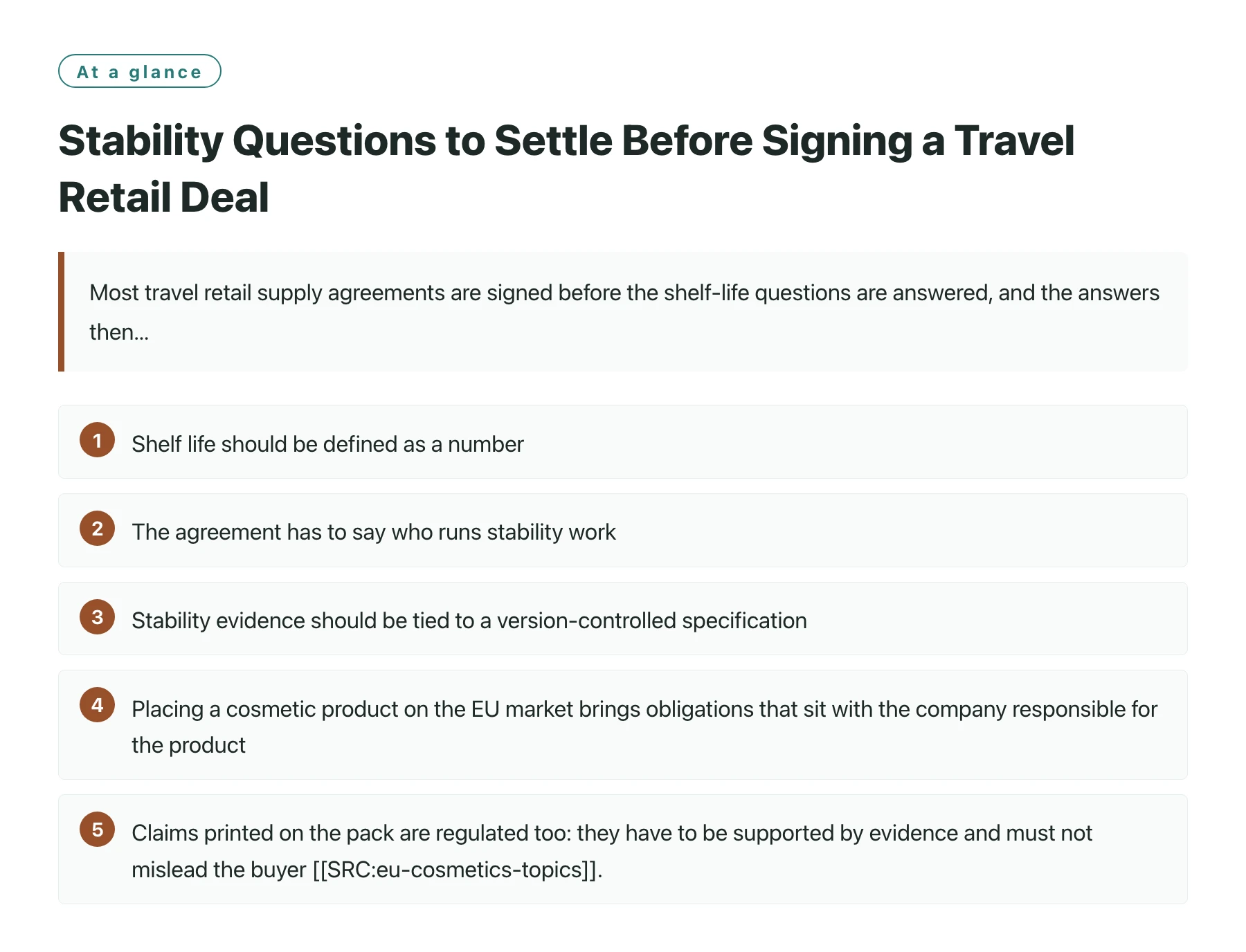
Key takeaways
- Shelf life should be defined as a number, a set of storage assumptions and a margin, not as a word like 'stable'.
- The agreement has to say who runs stability work, who pays for it, and who owns the report when the relationship ends.
- Stability evidence should be tied to a version-controlled specification, so a later formula change cannot quietly invalidate it.
- Placing a cosmetic product on the EU market brings obligations that sit with the company responsible for the product, not only with the factory that filled it [1].
- Claims printed on the pack are regulated too: they have to be supported by evidence and must not mislead the buyer [2].
A travel retail programme is usually agreed in a hurry, because the listing window is fixed by someone else's calendar. That pressure pushes the technical conversation to the end, where it arrives as a list of assumptions embedded in a quotation. The assumptions are the contract, whether or not anyone writes them down.
These are the questions worth settling first. They are ordered from the product itself to the commercial terms, because an answer to a later question often depends on an answer to an earlier one.
Questions about the product itself
What is the shelf life, and what is it measured against?
Ask for three things in one answer: the number of months, the storage conditions the number assumes, and the margin between the tested result and the claimed figure. A supplier that answers only with a number has skipped the part that matters, because the same formula can support very different claims depending on whether it is stored at 20°C or in a container on a quay.
Then ask what happens to the number if the pack changes. If the shelf-life claim was generated on a 50 ml crimped bottle and the retail listing needs a 30 ml bottle with a different pump, the claim has to be re-established or explicitly extended. Get the rule for that written down.
Which specification version does the evidence belong to?
Stability work is only meaningful against a frozen formula and a frozen component list. Before signing, confirm how specifications are versioned, who approves a change, and whether a change invalidates the existing evidence automatically or only on review.
This single clause prevents most of the arguments that follow a launch. Without it, a supplier can make a small substitution that is commercially invisible and technically decisive, and the brand has no agreed basis for objecting.
Who runs the stability programme, and on what samples?
Ask whether the work is in-house, subcontracted, or skipped in favour of material data sheets. All three are legitimate answers for different products; the answer only matters because it determines how much weight the report can carry.
Also pin down the sample source. A stability study run on laboratory-produced units is not the same as one run on units from the trial production line, and travel retail buyers increasingly ask which one they are looking at.
Questions about compliance and documentation
Which documents transfer to the brand, and in what format?
A dossier that exists as a PDF and a dossier that exists as editable source data are different assets. Decide before signature which one you receive, in which languages, and whether you may reuse it with a second filler if the relationship changes.
This is also the moment to agree on the safety documentation that supports the product in each market you plan to sell into, including who prepares it and who signs it.
What happens when a claim on the pack depends on the test result?
Claims such as long-lasting, refillable or travel-friendly are not decoration. They are statements that a market authority can ask you to substantiate, and the substantiation usually comes from the same testing programme. Ask which claims the supplier is willing to support in writing and which are the brand's own responsibility.
If a claim depends on a number, make the number's source part of the agreement. A claim that rests on a figure nobody can trace back to a protocol is the kind of finding that removes a listing.
Questions about money and ownership
Stability work has a cost and a duration, and both should appear in the commercial terms rather than in a later email. Who pays for the initial programme, who pays when the pack changes, and who pays for the re-test that follows a supplier-initiated substitution? Each of those is a real line item once the programme is running.
Ownership is the quieter question. If the brand paid for the work, the brand should hold the report and the underlying data. If the supplier paid, expect the supplier to hold it, and price the consequence into the negotiation. Neither arrangement is wrong; an unstated one is.
It also helps to know how far the supplier's own operation reaches. A a factory that handles fragrance R&D and production typically controls more of the chain, including the filling step where compatibility problems surface, which shortens the loop between a failed checkpoint and a corrected pack. Where the work is split across several vendors, the same failure takes longer to trace, and the agreement should name who coordinates it.
Before signature, walk the supplier's own verification checklist rather than your own. Reading the questions a manufacturer expects to be asked, such as Xuelei, is a fast way to find the gaps in your list, and it makes the conversation shorter because both sides are working from the same structure.
It is also worth reading what a supplier chooses to publish about itself before the meeting. The pages behind Xuelei fragrance brand will not answer any of the nine questions above, but they tell you which capabilities the company wants to be judged on, and that is a useful cross-check on what the sales conversation emphasises.
Who should own each answer
| Question | Owner on the supplier side | Document that closes it |
|---|---|---|
| Shelf life and its margin | Quality or regulatory lead | Signed stability summary plus observation log |
| Specification version control | Technical or R&D manager | Version-controlled specification with approval line |
| Responsibility for re-testing | Commercial owner | Clause naming the trigger and who pays |
| Document handover and reuse rights | Regulatory affairs | Document schedule attached to the agreement |
| Claim substantiation | Regulatory affairs with marketing | Written list of supported and unsupported claims |
If two of these five rows come back with the same name and no supporting document, the supplier is small enough that one person carries the whole technical file. That is workable, but it should be a known risk rather than a discovery.
Put every answer in the agreement as a numbered schedule, not in the covering email. The schedule is what gets read when something goes wrong six months later.
Sources
- European Commission: Cosmetics in the EU —— The European Commission's overview of EU cosmetics rules, including the responsible person, product information file and safety report requirements.
- European Commission: Cosmetic Products — Specific Topics —— EU pages covering specific cosmetics topics such as product claims, nanomaterials and animal-testing rules.
Frequently asked questions
Should a travel retail agreement include a shelf-life clause?
Yes. It should state the claimed shelf life, the storage assumptions behind it, the margin, and what happens to the claim when the formula or the pack changes.
Who pays for stability testing if the packaging changes mid-project?
Whoever caused the change, in most fair arrangements. The important step is naming the trigger in advance so the cost does not become a negotiation under time pressure.
Do we need a separate stability study for the tester bottles?
A tester is a different pack with different handling, so it deserves its own compatibility check, or at least an explicit written extension from the retail pack's result.
Can we rely on the supplier's material data sheets alone?
Material data sheets describe individual ingredients, not the finished product in its pack. They are an input to a stability programme, not a substitute for one.
What is a reasonable way to test whether a supplier answers honestly?
Ask one question whose answer you already know from a public source, such as your market's obligations for the party responsible for a cosmetic product, and see whether the reply matches the published position.
Ready When You Are
Let our locals build your Greek itinerary.
Tell us your dates and islands — we'll send a tailored ferry-and-stay plan in about 48 hours.
Plan My Greek Trip